

ToolsMay 13, 2025
Connect n8n with Facebook Messenger API via Webhook: A Comprehensive Guide 2025
Automating communication on messaging platforms has become an essential need for modern businesses. …
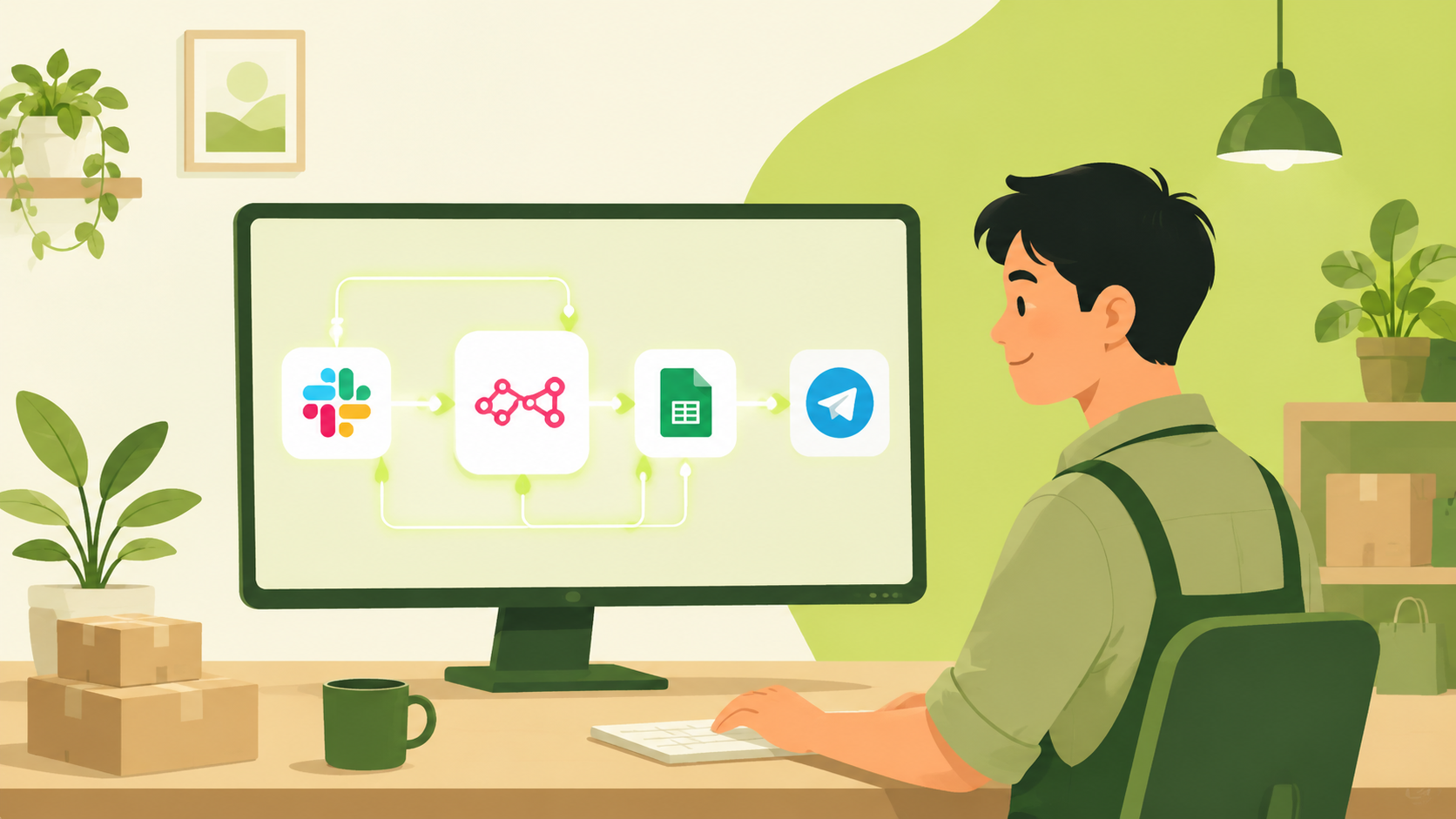
An SME with 8 employees, an average salary of 12 million/month. How many hours does the team spend on repetitive tasks each week — copying orders from Shopee to Sheets, answering the same questions on Messenger, preparing Meta Ads reports on Monday morning?
Quick internal survey by Benocode Team with 12 SME clients: on average20 hours/week/teamspent on these tasks. In monetary terms:1.5 million/person/weekwasted, ~6 million/team/month. Meanwhile, the 5 n8n workflows below — each set up in under 30 minutes — address most of these issues.
This article is not about 'what is n8n'. This article is5 n8n workflows the Benocode Team built for Vietnamese SME clientswith data flow diagrams + implementation outlines. You can copy-paste them directly.
Who should read this: SMEs with 5–50 employees, already have a marketing/sales team working manually. You don't need to know code, but you need someone (your team or an internal dev) to set up n8n in the first 1–2 days.Skip this if: team < 3 people (overkill), or already running Zapier well and budget is not an issue.
Pain: Lead capture forms on websites send leads to personal emails. Sales reps view them and manually copy them into Excel, writing individual reply emails. Each lead takes 8–10 minutes.
After the workflow: Leads from the form arrive in the CRM in 5 seconds with the correct segment tag, a personalized welcome email, and an auto-assign task for sales reps by region.

Implementation outline:
budget. Optional: node HTTP Request calls Clearbit/Hunter to enrich emails#new-leads for sales rep claimTime saved: ~3 hours/week (15 leads/week × 8 minutes/lead). Cost: free self-hosted n8n. If using n8n Cloud: $20/month Starter tier for 5,000 executions.
Practical reference: Benocode Team reviews n8n states that after 90 days, n8n replaced Zapier for 80% of workflows at 1/3 the cost. For simple lead capture cases, comparison of n8n vs Zapier shows break-even at 1,000 executions/month.
Pain: You sell on 3 channels. Every morning employees log into each platform, copy orders into a master Google Sheet for the warehouse team to pick. On busy order days, one employee sits for 2–3 hours.
After the workflow: Orders from any channel automatically push to the master Sheet, with Telegram notifications for the warehouse team as soon as new orders arrive (no waiting until the next morning).

Implementation outline:
order_id with the processed list (stored in Postgres or hidden Sheet tab) → skip old orders🆕 New order: {sp}, {sl}, {customer} — {address} to the warehouse team groupTime saved: ~5 hours/week. Bonus: response time for the warehouse team down from "the next morning" to "5 minutes".Caveat: Each platform has different rate limits. Lazada limits 5,000 calls/day — Schedule 5 mins × 288 times = 288 calls < limit, OK.
Pain: 70% of messages on Messenger are repeated questions ("how much?," "how long for shipping to province X?", "is there a warranty?"). The customer service team spends 6 hours/day responding manually.
After workflow: AI agent (Claude Haiku) automatically replies to repeated questions. Complex questions are escalated to humans.

Implementation outline:
Classify this message into one of three: - FAQ_SIMPLE: price/shipping/warranty/business hours - HUMAN_NEEDED: complaint/specific product inquiries - LEAD: bulk purchase/B2B Output JSON: {"intent": "X", "confidence": 0–1, "reasoning": "..."}
- FAQ_SIMPLE : call Anthropic a second time with system prompt = product knowledge base + brand tone. Response returned to Messenger. - HUMAN_NEEDED : post to Slack #cskh + tag the on-call rep. Reply to user "Transferred to customer service team, will respond in 15 minutes." - LEAD : create deals in CRM, tag #high-value-lead
Time saved: ~6 hours/week (30% case escalation deducted).Cost: Claude Haiku $1/M input + $5/M output. 1,000 messages/month ≈ $0.5–1.5.Cheaper than 1 cup of coffee per day.
Read more: Build AI customer support agent with n8n + Claude API — this article dives deep into building an agent with memory, cost ceiling, and eval set.
Pain: Performance marketers open Ads Manager every morning at 7 am, screenshot the dashboard, and paste it into Slack #marketing. If multiple accounts = 30 mins/day × 5 days = 2.5 hours/week just for reporting.
After the workflow: At 7 am, Slack automatically receives a card with yesterday's metrics, including an anomaly alert if CPL/CTR deviates >20%.

Implementation outline:
anomaly: true.#marketing-daily. If anomaly: add <@oncall> mention.Time saved: ~2.5 hours/week. Real bonus: detect run-away budget 1 day earlier = save 5–10% monthly spend. Expansion: add Shopee/Lazada Ads API similarly.
Pain: Marketers need to know 3 competitors' new blog/landing pages. Every Monday open 6 tabs manually = 1.5h/week.
After workflow: Monday morning Notion has a new database with 10–20 new competitor URLs + AI summary + homepage screenshot.
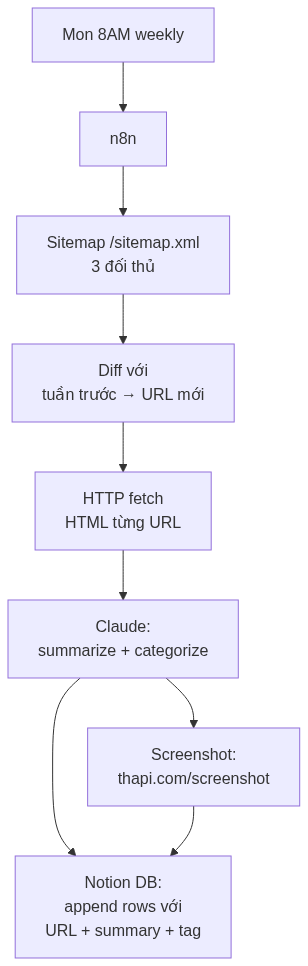
Implementation outline:
<title> , <meta description> , <h1> first 500 chars body.https://api.urlbox.io/v1/... (or self-host Playwright service) to get PNG.Time saved: ~1.5 hours/week. Bonus: catch new competitor launches within 7 days, not just when they go viral.Cost: ~$0.30/week (Claude + screenshot service).
All 5 workflows are under 50 nodes in n8n. If your team has 1 developer who knows basic JavaScript + 2-3 days to read the docs,you can self-build.
When to hire (Benocode Team or another agency):
Need advice on whether to self-build or hire? Schedule a 30-minute discovery call— the Benocode Team will discuss your case case-by-case, no pitch deck involved.
Is n8n really free?Self-hosting is 100% free (open source, fair-code license). Just need a VPS for ~$5/month (Hetzner, DigitalOcean). n8n Cloud has a Starter tier for $20/month if you prefer not to self-host.
Is n8n harder than Zapier?Yes, because the node-based interface is more complex than drag-and-drop. However, the power and cost savings are much greater when scaling. See n8n vs Zapier — choose based on use-case to decide.
Does a 5-person SME need n8n?If the whole team spends more than 5 hours/week on repetitive tasks → it’s recommended. Workflow #1 (lead capture) is enough to answer this question: if you receive >5 leads/week, automation is much cheaper than using people.
Will this workflow break if the platform changes the API?Yes, sometimes. Meta/Shopee changes their API every 6–12 months. You need someone to monitor and fix when it breaks. This is the main reason to hire a maintenance contract or have an internal developer to take care of it.
How long does it take to self-build?Workflow #1, #4: 4–6h. Workflow #2, #5: 8–12h. Workflow #3 (AI agent): 12–20h because it requires prompt tuning and evaluation. In total, if you build all 5: 1.5–2 weeks for one part-time developer.
Setting up a VPS to self-host n8n?See the self-host n8n guide on Render — Benocode Team has a setup script available, about 30 minutes from start to finish.
These 5 workflows are not everything — they are just the base set where 80% of SMEs see the quickest ROI. When you become familiar with n8n, you’ll discover another 20–30 workflows that can be automated: invoice generation, contract approval, employee onboarding, customer winback...
If you want:
Both paths are faster for teams spending 20h/week on repetitive tasks.
Article by Benocode Team. Tools used: n8n self-host, Claude Haiku, Slack, Google Sheets, Telegram bots. Last updated: 2026-05-08.
Automating communication on messaging platforms has become an essential need for modern businesses. …

In today’s rapidly evolving world of artificial intelligence (AI), MCP – Model Context Protocol – is…
In this era of digitalization and automation, optimizing workflows is one of the key factors that h…
We see AI as an investment — not a cost — for optimizing operations, marketing, sales, and customer support. But the right investment needs a roadmap, not trend-chasing. First 30-minute call is on us. No sales pitch. Just two founders talking about your business.