

Digital transformationMay 9, 2026
Spent 50 million on AI without results? 5 common SME issues
Discover why Vietnamese SMEs spend 50–200 million on AI with no ROI. Our framework offers insights w…
Recently, you received an email with friendly language, even with a witty greeting. You wonder: "Who wrote this email? This must be a real person." But surprisingly, it was an AI. So how much does AI resemble humans? Why is it full of potential for communication and customer experience optimization?
Today's AI has far surpassed the ability to communicate with machines in the past thanks to NLP (Natural Language Processing) technology. This is the key to helping AI not only understand the semantics of words, but also be able to "read" context, emotions, and even adjust communication styles in the most natural way. If you used to think of AI as a tool, now it's like a "core friend" — always ready to understand, listen, and accompany you every step of the way.

AI giống con người như thế nào
Factors that make AI natural:
AI technology not only helps communicate but also enhances the user experience in many fields. Here are some real-life examples
AI supports answering quickly, accurately, and always keeping a polite attitude. For example, when you ask about a flight schedule, the AI not only provides the right information, but also includes thoughtful reminders such as: "Don't forget to bring your passport!". Chatbots such as ChatGPT and Google Assistant are very popular in answering questions professionally but closely.

Customer care AI
AI not only sends emails, but also personalizes content, making recipients feel more interested. For example, the AI can send birthday wishes with a sentence such as: "Hope you receive many interesting surprises today!". This wish not only brings a smile but also makes the recipient feel that they are truly special.
AI helps create blogs, social media posts, and even poetry. However, calling it creative may be a bit of an exaggeration, as AI primarily works based on data that is already available. For example, if you need a new product introduction article, AI can quickly generate content with a headline like: "Discover ABC products today!". However, unexpected and breakthrough creativity is still something that AI cannot achieve, and users often need to edit or add to create true personalization. Tools like Jasper AI or Copy.ai are great helpers in content creation, but they still need human direction and fine-tuning to achieve optimal efficiency.
AI not only replaces but also enhances the communication experience, providing convenience and personalized connections that were not available before. This makes AI not only a tool, but an integral part of the human interaction journey.
AI is not only a tool, but also an ideal companion thanks to its outstanding capabilities:
AI never loses patience, always ready to support 24/7 tirelessly. This gives users peace of mind knowing that whenever needed, the AI will always be there to help without complaint or delay, creating a reliable and seamless support experience.

AI is friendlier than humans
AI ensures to provide reliable information when answers are already available in its data. However, when encountering questions beyond the scope of understanding, AI can generate inaccurate answers on its own, leading to confusion. This requires users to authenticate and verify the information clearly.
AI can flexibly change communication styles to suit each situation or user.
However, AI still has limitations, such as a lack of real emotions or the ability to understand deeply. For example, AI can respond politely, but it doesn't really sense human joy or sadness. In addition, AI cannot come up with groundbreaking creative ideas on its own, but only works based on existing data. This begs the question: Can AI replace humans entirely, or is it forever just an add-on tool in communication and creative situations?
AI not only plays a complementary role, but also contributes to improving communication efficiency and user experience. Although AI cannot completely replace humans, its progress has been bringing positive changes.
The next time you receive an email or online chat, think about it: Is it an AI? And if so, does it really matter when AI is doing a good job of supporting us?
Discover why Vietnamese SMEs spend 50–200 million on AI with no ROI. Our framework offers insights w…

Discover 5 simple yet highly effective AI workflows using popular platforms to boost productivity wi…
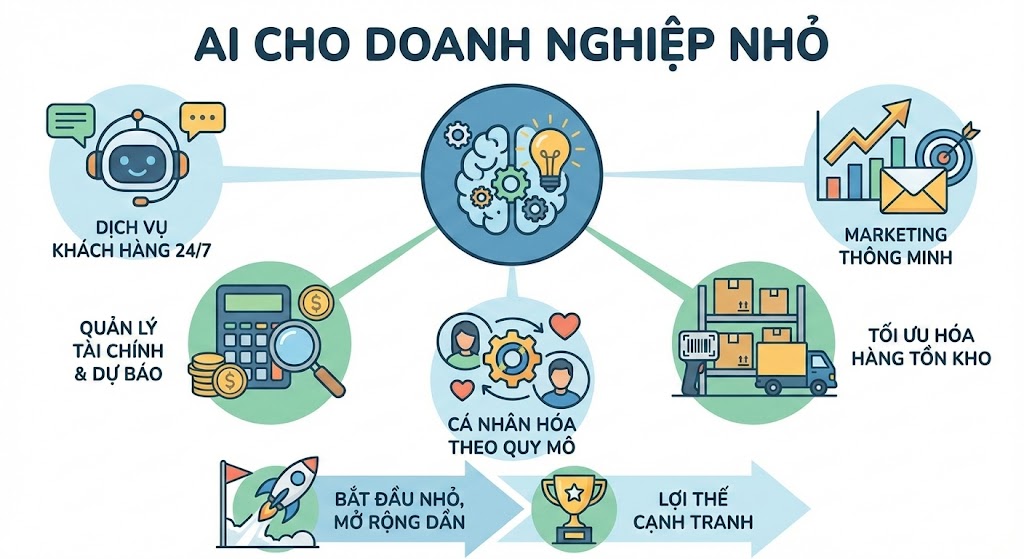
Discover how small businesses can leverage AI technology to compete effectively, optimize operations…
We see AI as an investment — not a cost — for optimizing operations, marketing, sales, and customer support. But the right investment needs a roadmap, not trend-chasing. First 30-minute call is on us. No sales pitch. Just two founders talking about your business.